Infection Prevention & Control
What’s changed in 2026 and what practitioners need to know
Scotland’s early years sector has seen significant updates to infection prevention and control (IPC) guidance in 2024–2026. These changes reflect new evidence, lessons learned from recent outbreaks, and a national commitment to improving health protection for children, families, and staff.
This section summarises the key updates, explains why they were introduced, and provides practical examples to help apprentices, practitioners and assessors apply the changes confidently in everyday practice.
🌟 Why Has the Guidance Changed?
Across the sector, infection risks have evolved. Public Health Scotland highlights that:
“Although we cannot stop all infectious diseases, there are simple ways to reduce how often we get sick and how often we pass on infections to others.”
The Care Inspectorate’s updated nappy‑changing guidance (July 2026) was introduced because:
“Gastrointestinal infections such as Norovirus, Salmonella, and E. Coli are highly contagious and may be spread within the nappy changing area if standard infection prevention and control procedures (SICPs) are not properly followed.”
The new guidance strengthens expectations around:
Environmental hygiene
Handwashing
Waste management
PPE use
Safe nappy changing facilities
Risk assessment
Staff practice and training
These updates ensure settings meet modern standards of safety, dignity, and infection control.
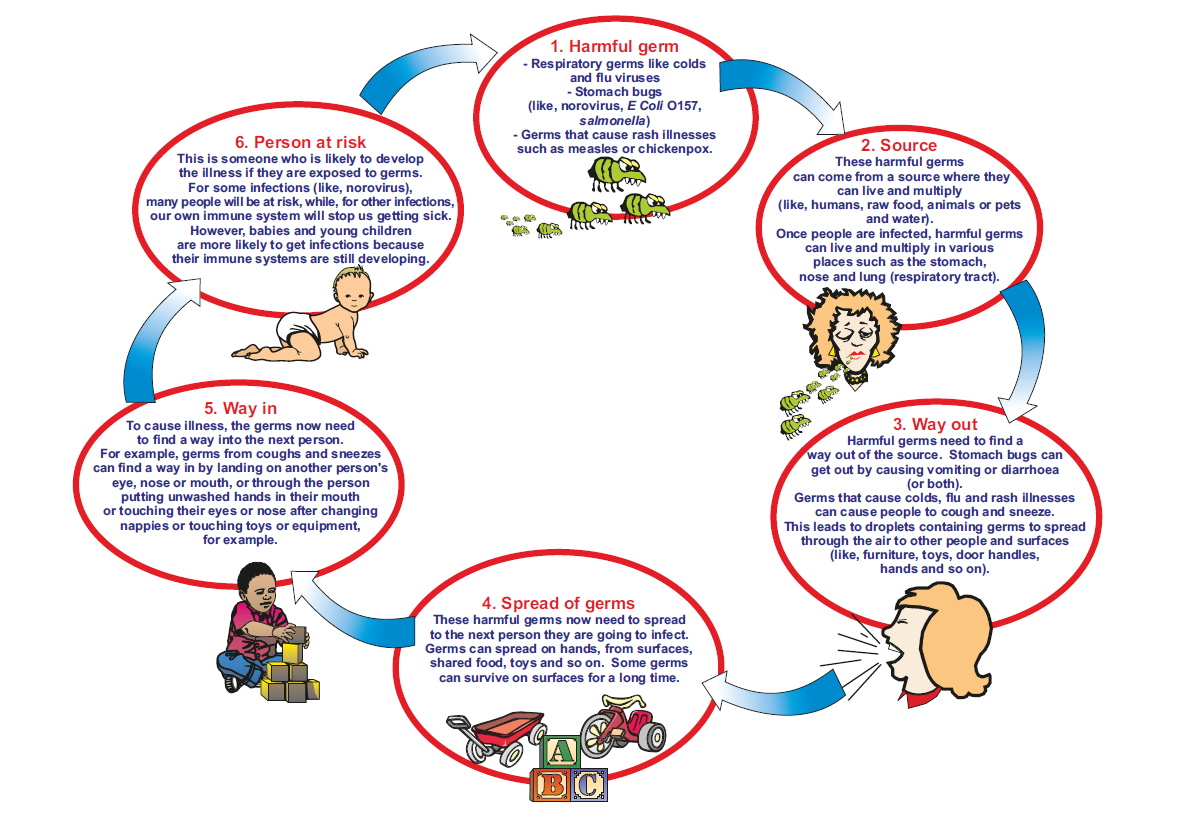
How do germs spread, Infection Prevention and Control in Childcare Settings, 2026, pg 4.
Key changes in 2026 (Compared to 2018 Guidance)
1. Stronger Requirements for Nappy Changing Facilities
The 2026 Care Inspectorate guidance now states:
“There must be a minimum of one nappy changing facility for every 10 children using nappies.”
This was not specified in the 2018 guidance.
What this means in practice:
Settings must review capacity and ensure ratios are met.
Assessors should check facilities during planning and variation requests.
Apprentices should understand why ratios matter for infection control and dignity.
2. Clearer Expectations for Staff Practice During Nappy Changing
The updated guidance emphasises:
“Nappy changing areas will be cleaned before and after use… The interaction will be relaxed, happy and social.”
This strengthens the link between infection control and high‑quality interactions, which was less explicit in 2018.
Practical example:
Practitioners should narrate what they are doing, maintain eye contact, and use warm, responsive language while still following strict hygiene routines.
3. Updated Handwashing Standards
Public Health Scotland’s 2026 guidance provides expanded detail on:
“Hand washing should be done at the right time, with the correct products, facilities and procedures.”
The 2018 guidance focused on technique; the 2026 version adds:
Outdoor handwashing expectations
Emergency alternatives
Teaching children hand hygiene
Links to national resources
Practical example:
Outdoor nurseries must provide warm running water handwashing stations or approved alternatives—not rely solely on wipes.
4. Enhanced Waste Management Requirements
The 2026 nappy‑changing guidance states:
“There should be a separate bin for disposable nappies, which should be foot‑operated, lined, and lidded.”
This is more specific than the 2018 guidance.
Practical example:
Apprentices should be able to identify correct bin types and explain why lidded, foot‑operated bins reduce aerosol spread.
5. Updated Guidance on Potties and Continence Aids
The new guidance requires:
“Designate a sink for cleaning potties (not a hand wash basin)… Store potties upside down. Do not stack potties inside each other.”
This is more detailed than the 2018 appendix.
Practical example:
Practitioners must disinfect any non‑designated sink immediately after use if a dedicated potty sink is unavailable.
6. Stronger Focus on Risk Assessment
The 2026 guidance emphasises:
“Regularly review your risk assessments… One‑off risk assessments may be needed for specific activities.”
This aligns with modern health protection expectations.
Practical example:
A one‑off risk assessment should be completed for messy play involving water, soil, or shared sensory materials.
7. New Emphasis on Health Inequalities
The 2026 guidance recognises:
“Health inequalities are unjust and avoidable differences in people’s health.”
This was not present in the 2018 guidance.
Practical example:
Settings should provide translated exclusion letters or Easy Read versions for families with literacy or language barriers.
🧼 Practical Examples for Apprentices & Practitioners
✔ Before a Nappy Change
Wash hands.
Prepare PPE.
Gather labelled creams and wipes.
Ensure the area is clean and clutter‑free.
✔ During a Nappy Change
Maintain warm, responsive interaction.
Keep the child’s dignity central.
Follow SICPs (gloves, aprons, correct disposal).
✔ After a Nappy Change
Clean the changing mat and surrounding area.
Dispose of waste in the correct bin.
Wash hands again.
Record any concerns (rash, diarrhoea, unusual odour).
📘 Direct Link to Updated Guidance
Care Inspectorate – Nappy Changing Guidance (July 2026)
This is the most up‑to‑date national guidance and should be used in all assessment planning and staff training - https://ci-web-media-production-bucket.s3.eu-west-2.amazonaws.com/assets/resources/nappychanging/nappy-changing-guidance-06072026.pdf
Public Health Scotland – Health Protection for Early Years Settings (2026)
Provides the full IPC framework for nurseries, childminders, and outdoor settings - https://publichealthscotland.scot/media/40241/health-protection-in-early-years-and-childcare-settings-v1-print.pdf
Listen as Richard provides an overview on the Care Inspectorates Nappy Changing guidance.
For a full overview of this topic you might want to listen to the podcast below.